 Packaging
Packaging
Packaging
There's something about the heft of a formal gift box. The heavy paperboard, the satin lining, the magnetic catch that clicks shut with a satisfying click. We (usually) rip off the wrapping paper and look at the box for 3 seconds, then throw it in the recycling. But that box, the one that once held a watch, a perfume set, or a pair of cufflinks, could be the ideal solution to storing your ever-growing collection of cables, drives, and other tech.
Let me explain why it's time to rethink that formal gift box, and how to transform it into a personalized electronics organizer that outperforms anything you can buy from a discount store.
Why Formal Gift Boxes Work So Well for Tech
Formal gift boxes are not like regular boxes. They are constructed of stiff board, so they won't bend or sag. The hinges are reinforced. The lids are secure - no tape or bands required. Often, you will find removable trays, foam inserts, or even fabric dividers inside that add to the cost of the box and are not found in standard storage boxes.
Electronic devices must be protected from shock, static, and water. You already have impact protection through the box walls. The lining of the box (typically velvet, faux suede, or satin) is already low and soft, so it will not scratch screens. With some tweaks, you've got a mobile workstation that doesn't look like a shoebox on your desk.
The Conversion Process
You'll need a box with at least 2 inches of depth. Boxes with little or no depth can hold thumb drives and SD cards, but deeper boxes hold external drives, charging cords, and headsets.
- Step one: Pop out or repurpose the tray. Fancy boxes sometimes have a foam insert designed for a particular product. Pop it out carefully. If it's flexible foam, you can carve out new spaces for your equipment with a sharp utility knife. If it's hard plastic, take it out and save it.
- Step two: Insert walls. You don't have to be a carpenter. You can use heavy cardstock, bookbinding material, or even multiple layers of corrugated cardboard. Take the internal measurements of width and height, cut the dividers, and wrap them in felt or sticky-back velvet (available at craft stores for around $5 a sheet). Use tacky glue or a hot glue gun to affix them. Let it dry overnight.
- Step three: Line the lid. Many gift box lids are lined with cardboard. But not if you want to stash flat items (memory cards, cables, a flat power bank) against the lid. Cut a piece of self-adhesive foam sheet or cork panel to fit inside the lid, then stick it in place and glue small, elastic bands in a grid to hold items against the lid when the box is shut.
- Step four: Manage cables. This is where most organizers fail. When you shut lids, cables tangle. The solution is easy: cut some small pieces of hook-and-loop tape (Velcro), tape one side to the bottom of the box in rows, and wrap the other around each cable coil. The cables stay put. No slipping, no snarls.
What to Store in Your Converted Box
A quality gift box is worth three or four times as much as a dollar box. Here's a typical layout in a medium-sized box (around 10 x 8 x 3 inches):
- Left side: Upright bricks and wall adapters.
- Middle row: Coiled USB-C, Lightning, and micro-USB cables, tied with a cloth tie.
- Right side: A padded space for an external or portable hard drive/SSD.
- Inside the lid: SD cards, a USB hub, and a mini multitool secured with elastic bands.
- Inside the tray (if you have one): paper documents, SIM card adapter, backup keys.
- It's not about stuffing it full. It's all about being able to open the box and find what you need.
A Note on Custom Gift Card Boxes
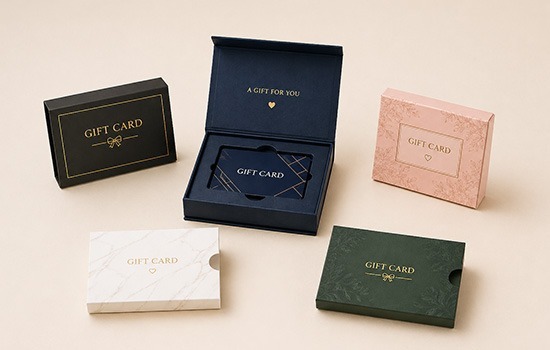
If you're buying boxes for this project, consider custom gift card boxes offered by stores that carry upscale stationery and gift items. Those boxes are made with tight tolerances - the lid snaps on exactly right, corners are heavily reinforced, and the inside is often bare or contains only a single sheet of paper that can be removed. They are also available in bulk from some packaging suppliers for less than two dollars each (empty). A custom gift card box is a blank slate: no logos, no funky shapes, just the shell of a box to put in dividers and foam.
Avoiding Common Mistakes
Avoid a box that is perfumed or cedared. The smell will rub off and won't come out of the warm plastic and rubber parts. If the box includes a ribbon or paper shreds, remove them. Paper shreds can fall out and, well, paper shreds.
Include a lid latch. Most formal box lids are held closed by gravity, but they open when the box is dropped on its side in the car or your bag. Staple a leather strap to the front of the lid with a snap button, or glue two neodymium magnets into the front edge of the box and the lid. Be sure to test the polarity before gluing.
Why This Is Better Than New
A brand-name electronics organizer costs $20 to $60. It could be nylon or thin foam, and it looks like a travel organizer. A recycled gift box is free (if you have one) or cheap (if you buy an empty one). It's a piece of art. And it opens up to show the contrast between the high-falutin' outside and the orderly insides, which gets you a small nod of appreciation from your friends.
Don't miss
-
How to Choose the Right Essential Oil Box Packaging for Retail Success?
June 17, 2026
-
Why Boutique Boxes Are Redefining Retail Packaging with Style and Identity
April 30, 2026
-
Top 20 Global Packaging Companies Leading the Industry in 2026
March 17, 2026
-
Top 10 Packaging Companies in the USA (2026 Industry Leaders)
March 16, 2026
-
20 Different Types of Boxes Used in Packaging Industry (Complete Guide)
March 4, 2026

.jpg)